

By Ben Allen
The ceiling on the state and local tax deduction has quadrupled. Whether it helps you depends on where you live, what you pay and how you file. For some households, it may also create a valuable opportunity to make charitable giving more tax-efficient.
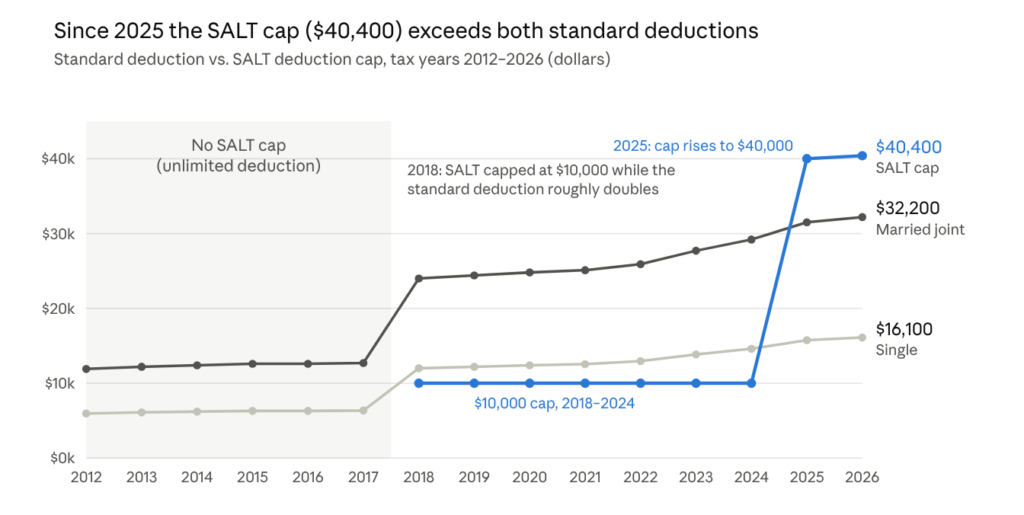
The state and local tax (SALT) deduction lets taxpayers who itemize deduct what they pay in state and local income (or sales) taxes and property taxes. For decades there was no dollar limit. That changed in 2018, when the Tax Cuts and Jobs Act capped the deduction at $10,000 while nearly doubling the standard deduction, which moved millions of households away from itemizing. In July 2025, the One Big Beautiful Bill Act (OBBBA) raised the cap to $40,000 for 2025 and $40,400 for 2026, with 1% annual increases through 2029. Under current law the cap falls back to $10,000 in 2030. The cap is the same for single and joint filers, and it phases down toward a $10,000 floor for modified adjusted gross income above $505,000 (2026). For some households, this change is about more than deducting additional state and local taxes: it may also reopen the door to itemizing deductions, and make charitable contributions more valuable from a tax-planning perspective.
The standard deduction is the bar to clear
Think of the standard deduction as the bar in a pole-vaulting competition. Your itemized deductions are the vaulter’s approach and lift: state and local taxes, mortgage interest, and charitable contributions all help build the total. The standard deduction is the height you have to clear.
If your combined deductions fall short, you simply take the standard deduction. But when the higher SALT cap allows you to count more of your state and local taxes, it can provide the extra lift needed to get over the bar. For households that are close, a charitable contribution may provide the final push that clears it.
The key point: Once you clear the bar, every additional dollar of allowable itemized deductions above the standard deduction can contribute to additional federal tax savings. SALT only matters if you itemize, and you only itemize when your total itemized deductions exceed the standard deduction. The chart below shows the standard deduction for single and married-joint filers since 2012 alongside the SALT cap. The standard deduction roughly doubled in 2018, just as the cap arrived. The 2025 increase puts the cap above both standard deductions for the first time since it was introduced.
How much more do you need to itemize?
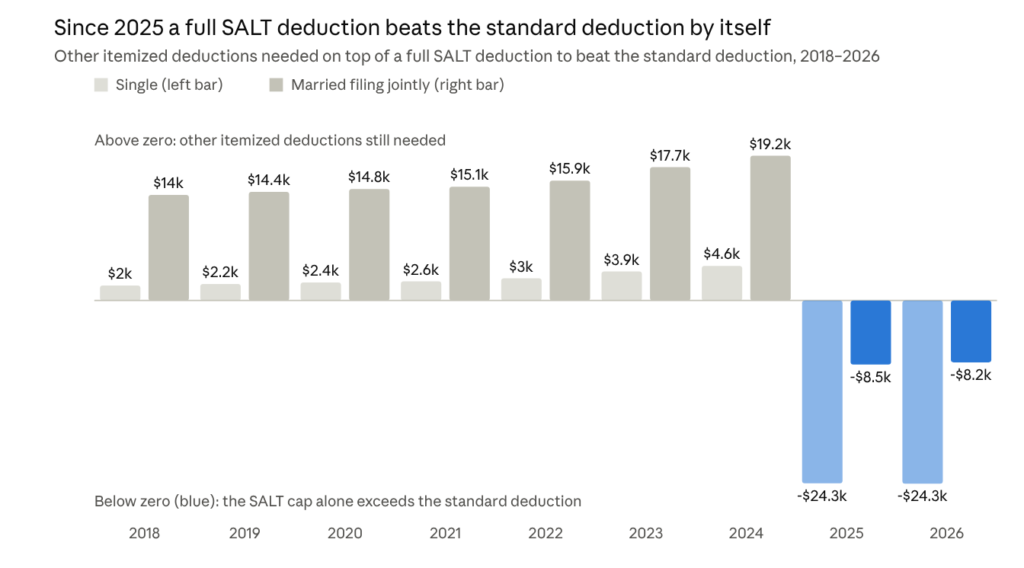
The second chart subtracts the SALT cap from the standard deduction. From 2018 through 2024, a joint filer who paid the full $10,000 in SALT still needed $14,000 to $19,200 of other itemized deductions to come out ahead. Beginning in 2025, a household that pays the full cap in state and local taxes clears the standard deduction on SALT alone. Many households pay far less than the cap, though, which is why the benefit is so uneven. For households closer to the threshold, charitable contributions may provide the additional deductions needed to make itemizing worthwhile.
Two households, two very different outcomes
The examples below are hypothetical. Both are married filing jointly, use 2026 figures (a $32,200 standard deduction and a $40,400 SALT cap), and assume a 24% marginal federal bracket.
Household A: a high-tax state, modified AGI of about $320,000. This couple pays $17,000 in state income tax and $14,500 in property tax, for $31,500 of SALT. They also have $13,000 in mortgage interest and $6,000 in charitable gifts. Under the old $10,000 cap, their itemized total would have been $29,000, below the standard deduction, so they would have taken the standard deduction. Under the 2026 cap, their itemized total is $50,500. That is $18,300 above the standard deduction and worth roughly $4,400 in federal tax. The charitable contribution is an important part of this equation: the higher SALT deduction makes itemizing possible, while the $6,000 gift adds to their itemized deductions.
Household B: a lower-tax state, modified AGI of about $150,000. This couple pays $4,500 in state income tax and $5,500 in property tax, for $10,000 of SALT. They also have $4,000 in mortgage interest and $2,000 in charitable gifts. Their itemized total is $16,000, about half the standard deduction, so they take the standard deduction just as they would have under the old cap. Their SALT already fit within the old limit, so the higher cap changes nothing for them. Their charitable contributions remain meaningful, but neither the higher SALT cap nor their existing deductions are sufficient to make itemizing advantageous.
| Household A | Household B | |
|---|---|---|
| SALT paid | $31,500 | $10,000 |
| SALT deductible under the old $10,000 cap | $10,000 | $10,000 |
| SALT deductible under the 2026 cap | $31,500 | $10,000 |
| Charitable contributions | $6,000 | $2,000 |
| Mortgage interest | $13,000 | $4,000 |
| Total itemized deductions (2026) | $50,500 | $16,000 |
| Better choice | Itemize | Standard deduction |
| Federal tax benefit from itemizing vs. standard deduction | About $4,400 | $0 |
Very high earners are a third case. Households with modified AGI above $505,000 see the cap phase down toward $10,000, so the higher cap does little for them even if they pay far more than that in state and local taxes.
An overlooked opportunity: Making charitable giving more tax-efficient
One of the more interesting implications of the higher SALT cap is its potential impact on charitable giving. A charitable contribution generally provides a federal income tax deduction only when a taxpayer itemizes deductions, subject to applicable rules and limitations. A limited above-the-line deduction for certain cash gifts by non-itemizers is also available under the new law.
For households that previously took the standard deduction, charitable contributions often provided no additional federal income tax benefit. The higher SALT cap may change that equation.
Charitable giving can help push you over the itemization threshold.
If state income taxes, property taxes and other deductions bring you close to the standard deduction, a charitable contribution may be the additional deduction that makes itemizing worthwhile. For example, a married couple with $28,000 in deductible SALT and $2,000 in other itemized deductions would have $30,000 in total deductions. A $5,000 charitable contribution would bring that total to $35,000, exceeding the $32,200 standard deduction.
Charitable contributions can add to deductions you are already receiving.
For households that already exceed the standard deduction because of their SALT payments, charitable contributions can increase their total itemized deductions further. In Household A, the $6,000 charitable contribution is part of the $50,500 in total itemized deductions. At a 24% marginal tax rate, each additional dollar of deductible charitable giving may generate approximately 24 cents in federal income tax savings, assuming the gift falls within applicable deduction limitations and the household remains in the same tax bracket. The tax benefit does not make giving free; it may reduce the after-tax cost of supporting a cause.
The timing of charitable gifts may matter more than ever.
Because the higher SALT cap is scheduled to revert to $10,000 in 2030, households have a limited window to take advantage of the expanded deduction. For those who are already charitably inclined, this may be an opportunity to reconsider the timing of their contributions. Coordinating charitable gifts with property tax payments and other deductible expenses could help maximize the benefit of itemizing in a particular tax year.
For some families, strategies such as bunching multiple years of charitable contributions into a single tax year or establishing a donor-advised fund may be worth exploring. These approaches can allow families to maintain consistent charitable support while concentrating deductions in years when itemizing is most advantageous. The tax benefit should complement charitable intentions, not dictate them.
Why timing matters
The higher cap is not permanent. It rises just 1% a year through 2029 and is scheduled to revert to $10,000 in 2030 unless Congress extends, changes or ends it first. That leaves a limited number of tax years to take advantage of it, and 2026 is almost over. For households like Household A, and for those sitting near the line, choices about when to pay property taxes, how to time charitable gifts and how to structure other deductible expenses can change the outcome materially. If you are already supporting organizations and causes that matter to you, the expanded SALT deduction may create an opportunity to make those contributions more tax-efficient. If you have been taking the standard deduction for years, it may be worth revisiting whether your circumstances have changed enough to make itemizing beneficial. Talk with your financial advisor and tax professional before year-end to evaluate your SALT deduction, charitable giving strategy and other itemized deductions.
The views expressed herein, including those of guests not affiliated with Bluespring Wealth, reflect the opinions of the author or speaker as of the date of publication, are not statements of fact, and are subject to change without notice. This communication is provided for informational and educational purposes only, does not constitute investment, tax, or legal advice. Any references to specific securities, products, or services do not constitute a recommendation or endorsement. All forward-looking statements and projections are subject to uncertainty and should not be relied upon as predictions of future results. All investments involve risk, including the possible loss of principal. Past performance of any security, index, strategy, or market is not indicative of future results. Any index performance referenced herein is provided for informational context only; indices are unmanaged, do not incur fees, and are not available for direct investment. Diversification and active management do not guarantee a profit or protect against loss in declining markets. Statistical data attributed to third parties is believed to be from reliable sources but has not been independently verified. Bluespring Wealth complies with the requirements of the SEC’s Marketing Rule with respect to the payment of referral fees or other compensation to promoters.
Investment advisory services offered through Bluespring Wealth Management, LLC, a registered investment adviser. Bluespring Wealth is a network of affiliated firms including BWM. Bluespring Wealth Management LLC does not provide legal or tax advice.