

By Logan Gilland, CFP®
Eyes glazed over and a blank stare is usually the response I get when I start talking about bonds. Not so much with the recent headlines over the last few weeks. Most people own bonds but have very little understanding of how they actually work. My goal by the end of this piece is to make what is, for many, the most confusing part of their portfolio the easiest to understand.
The Basics
A bond is a loan. It is much easier for us to understand this topic when we are the ones taking out the debt, but a bond is basically just an interest only mortgage where we are the bank. The borrower pays you interest over a period of time and then pays you back the principal at the end.
Plenty of businesses and governments issue bonds and are happy to borrow from you, but the largest borrower in the world, by far, is the United States government, with about $40.1 trillion in outstanding IOUs. Uncle Sam is the friend who always forgets his wallet.
Let’s take a look at how a bond works and the definitions that help to understand it. First, a note on semantics. Not all U.S. government debt is technically a “bond.” It can also be called a bill, or a note depending on how long the loan is intended to last. For the purposes of this explanation, I am going to call everything a bond.
- Face Value: What you get back at the end, usually $1,000 for a single bond.
- Maturity: The date the loan ends and you get your face value back.
- Coupon: The interest the bond pays each year, as a percentage of face value. On a $1,000 bond with a 4 percent coupon, that is $40 a year, usually paid twice a year or $20 every 6 months.
- Yield: The return you earn based on the price you actually paid. It moves with the market, and it is the number you hear about in the news.
Basic Example: Let’s look at the simplest version, a one year Treasury bond. This one pays no coupon at all. Instead, you buy it at a discount and get the full face value back at maturity. Say you pay $960 for one bond. In exactly one year, the government pays you $1,000. That $40 difference is your entire return. Divide it by the $960 you invested and you get about 4.2%. That is the bond’s yield, and because it is exactly one year, it is also your yearly return. No coupon, no payment schedule, no moving parts. You lend the money, wait one year, and get back more than you put in.
Why Bond Prices Move
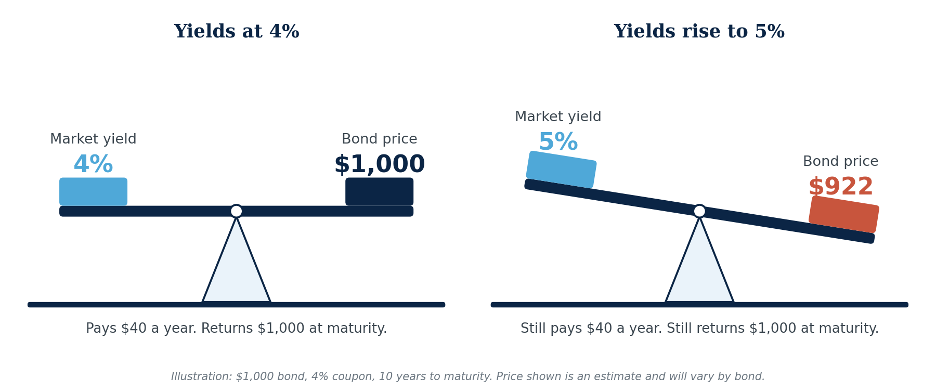
Bond yields and bond prices sit on opposite ends of a teeter totter. When one goes up, the other goes down. This is where most of the confusion, and most of the worry, comes from.
Say you own a $1,000 bond paying a 4 percent coupon, or $40 a year. Then interest rates rise, and a brand new bond comes out paying 5 percent. Nobody is going to pay full price for your 4 percent bond when 5 percent is available down the street. To sell yours, you would have to lower the price until the buyer’s yield catches up. On a bond with 10 years to go, that price would land around $922.
That drop is what shows up on your statement when rates rise, and it is why the “safer” part of a portfolio has felt uncomfortable lately.
Not every bond swings the same amount. The longer the time until maturity, the further the teeter totter tilts. A one year bill sits at the short end, which is why it barely moves when rates change. In this same example, a one point rise in yields would move a one year bond about 1 percent, a 10 year bond about 8 percent, and a 15 year bond about 10 percent. That is why the headlines focus on the 10 year and 30 year Treasury. Those rates move the most when expectations about interest rates change.
What Did Not Change
Look at the right side of the graphic again. Your bond still pays $40 a year. It still matures on the same date. And if the borrower holds up their end, you still get your full $1,000 back. The lower price only turns into a real loss if you sell at the bottom. As a bond gets closer to maturity, its price gets pulled back toward $1,000.
How We Invest
Most investors own bond funds instead of individual bonds, and that is what we use in the majority of our portfolios. A fund works like a basket of stocks, except the basket holds hundreds or thousands of bonds. Some of those bonds mature soon and some mature years from now. The fund then passes the interest they earn along the way to the investor. As older bonds mature, the fund puts that money to work at today’s higher rates. Longer term bonds are paying about 5% right now, with shorter ones a bit less, so investors are being paid more to own bonds than they were a few years ago.
For clients, we stick to the safer parts of the bond market, mostly U.S. Treasuries and high quality corporate debt. Bonds are not intended in your portfolio to win big. They are intended to pay income, steady the ride when stocks get bumpy, and they give you a stable place to draw from so you are not forced to sell stocks at a bad moment. That job has not changed.
Many people I talk to are worried the bond market is going to fall apart. Let’s take a step back. Safer bonds are not like stocks. A poorly run company can go to zero, but a bond backed by the federal government does not work that way. If the U.S. government ever stopped paying its bills, we would have much bigger problems than our account values.
It has been a tough few years, and you may look at a recent statement and wonder why we own these things at all. Remember however that if rates come down, the teeter totter tips back the other way and prices rise. Bonds can and have in the past have significant increases to their value if interest rates come down. Right now, the war in Iran is keeping inflation higher in the short term and expectations for rates elevated over the long term. That could flip. Until it does, we are being paid to wait.
The Real Concern
I walked through all of this to show that our concern when looking at client portfolios is not the bonds themselves. It is what a large increase in yields does to the stock market. Here are the three things I am watching.
First, companies pay more to borrow. I talked about this in depth in “Understanding Interest Rates,” but higher yields across the board mean a higher cost of debt for companies. That squeezes profit margins and can pull down stock valuations and prices.
Second, the government pays more to borrow. Imagine getting a 7 percent mortgage instead of a 3 percent mortgage. That new payment is not fun, and the same is true for the government’s debt year over year, which pushes the national debt even higher.
Third, big investors may shift. Large institutions could start rebalancing toward bonds that are now paying high yields, which could mean selling stocks to buy them.
All three are legitimate concerns for a stock market that has been shaky at best this year. I do see a lot of bright spots, though. Earnings have stayed strong (and that season is about to kick back into high gear), continued adoption of AI is leading to better productivity in companies, and the jobs market seems relatively healthy all things considered. We certainly have to keep watching how the bond market influences the stock market and how the ongoing war continues to affect interest rates.
The bond side of your portfolio is not the part that concerns me. Seeing red on a statement is never fun, but those funds are paying you more than they have in years, and that income keeps resetting higher as older bonds mature. When stocks are down, we take a deep breath and look at the bigger picture. Bonds deserve the same patience. Bonds may seem boring at times but when it comes to bonds boring is also the point.
Talk again soon,
Logan

Logan Gilland, CFP®, is Director of Wealth Management at Bluespring Wealth’s Lexington office, where he helps clients turn financial goals into practical plans. He also shares straightforward financial guidance through the DIY Money podcast, Savings & Sense radio show, and his weekly newsletter, Logan’s Lens. Outside the office, Logan and his wife, Hannah, enjoy hosting friends and planning their next national park trip.
The views expressed herein, including those of guests not affiliated with Bluespring Wealth, reflect the opinions of the author or speaker as of the date of publication, are not statements of fact, and are subject to change without notice. This communication is provided for informational and educational purposes only, does not constitute investment, tax, or legal advice. Any references to specific securities, products, or services do not constitute a recommendation or endorsement. All forward-looking statements and projections are subject to uncertainty and should not be relied upon as predictions of future results. All investments involve risk, including the possible loss of principal. Past performance of any security, index, strategy, or market is not indicative of future results. Any index performance referenced herein is provided for informational context only; indices are unmanaged, do not incur fees, and are not available for direct investment. Diversification and active management do not guarantee a profit or protect against loss in declining markets. Statistical data attributed to third parties is believed to be from reliable sources but has not been independently verified. Bluespring Wealth complies with the requirements of the SEC’s Marketing Rule with respect to the payment of referral fees or other compensation to promoters.
Investment advisory services offered through Bluespring Wealth Management, LLC (BWM), a registered investment adviser. Bluespring Wealth is a network of affiliated firms including BWM. The views expressed herein, including those of guests not affiliated with Bluespring Wealth, reflect the opinions of the author or speaker as of the date of publication, are not statements of fact, and are subject to change without notice. This communication is provided for informational and educational purposes only, does not constitute investment, tax, or legal advice. Any references to specific securities, products, or services do not constitute a recommendation or endorsement. All forward-looking statements and projections are subject to uncertainty and should not be relied upon as predictions of future results. All investments involve risk, including the possible loss of principal. Past performance of any security, index, strategy, or market is not indicative of future results. Any index performance referenced herein is provided for informational context only; indices are unmanaged, do not incur fees, and are not available for direct investment. Diversification and active management do not guarantee a profit or protect against loss in declining markets. Statistical data attributed to third parties is believed to be from reliable sources but has not been independently verified. Bluespring Wealth complies with the requirements of the SEC’s Marketing Rule with respect to the payment of referral fees or other compensation to promoters.