

By Logan Gilland, CFP®
Renewed tensions between Iran and the United States, combined with exceptionally high earnings expectations, created a challenging backdrop for the markets this week. Recent high-flyers like semiconductors and technology have taken the biggest hits. As we close out the week, I’m working on a follow-up piece that breaks down what happened and why it matters, so watch for that soon. In the meantime, I wanted to tackle a question that’s been top of mind for a lot of clients lately. I hope you find it helpful.
Every few years, a new savings option for kids shows up and everyone starts asking the same question. Do I need this? Right now that question is about Trump Accounts, and it is a fair one to ask.
The truth about saving for children is that it is not one size fits all. Like a good meal, you need to curate your strategy for the family you are cooking for. I think having components of each of these while balancing how much of each is the best strategy.
529 Plan
A 529 plan is a savings account built specifically for education. Contributions grow tax free, and withdrawals come out tax free too, as long as the money goes toward qualified school expenses like tuition, books, or room and board. These have expanded in recent years with the ability to use funds for K-12 tuition, student loan repayments, and even conversion to a Roth IRA if funds remain in the account.
Where it shines: This is the starting point for most families’ education savings. If the funds are used for education, the tax treatment is hard to beat, many states add a deduction or credit on top of it, although not in Kentucky, and the ability to convert to a Roth IRA allows for more options than in previous years. You also stay in control of the account even after your child turns 18, which is not something every option on this list can say.
Where it falls short: The tradeoff for all that tax benefit is that the money is earmarked for one purpose. Before the Roth conversion rule was in place, I was lucky enough to get scholarships and work as a Resident Advisor on campus, so I hardly had any college expenses. Because of that, my parents had a 529 built up that I then could not use for a down payment on a house, a car, or something else that could have kickstarted my career. The new rule allowing Roth conversion is a good one, but it comes with a $35,000 lifetime limit and requires the account to have been open for 15 years.
Custodial Account (UGMA/UTMA)
A custodial account holds money in your child’s name that can be used for anything that benefits them, not just education. There are no contribution limits, outside of annual gifting limits for tax reporting purposes, and no income restrictions, and it is simple to open.
Where it shines: Flexibility is the whole point here. This money can go toward a car, a wedding, a first apartment, or anything else your child needs down the road, not just tuition. This account also offers flexibility when it comes to investments and allows for individual stock investing, making it a good tool for teaching kids about markets. If you are diligent in tax managing these accounts, you can avoid what is called the kiddie tax and keep the tax liability small to nominal.
Where it falls short: There is not much of a tax advantage if you do not manage it appropriately. After the first $2,700 of interest, dividends, or capital gains, earnings get taxed at the parents’ tax rate. The other big holdup is that once the money goes in, it legally belongs to your child. There is no changing your mind later, and they gain full control once they hit the age of majority, usually 18 or 21 depending on your state, 18 in Kentucky. This account can also work against you if you are counting on financial aid for college, since the funds are in the child’s name and are weighted more heavily than a 529 or an account in the parents’ name.
Keeping It in the Parent’s Name
Some families skip a dedicated account altogether and just keep money set aside in their own name in a brokerage account, non-retirement, mentally earmarked for their kid’s future.
Where it shines: This is about as flexible as it gets and gives parents the most control. You decide when, how, and if the money ever actually goes to your child, and there is no paperwork or account restrictions to deal with. It is also the most favorable option from a FAFSA or financial aid perspective.
Where it falls short: There is no tax advantage, since the money grows and gets taxed inside the parents’ own bracket. There is also no real structure separating it from the rest of your finances, which makes it easy to tap into if an emergency happens.
Trump Account
Officially called a 530A account, this is the newest option on the list. Think of it as a starter IRA for kids, built for retirement decades down the road rather than college or a first car. Contributions can begin after July 4, 2026, and eligible children born between January 1, 2025 and December 31, 2028 receive a $1,000 government contribution just for opening one.
Where it shines: If your child qualifies for that government contribution, it is close to free money. On top of that, a $6.25 billion charitable gift from Michael and Susan Dell will add an additional one time $250 for the first 25 million eligible children age 10 and under living in zip codes with a median income below $150,000, on top of the standard $1,000 seed deposit (White House release). There is no earned income requirement and no income restrictions on who can contribute, and individual contributions go in after tax, so only the earnings get taxed later. It is a great way to get a head start on retirement for your child if you are looking to help them beyond their college years. If you are strategic with the tax planning, there should also be good opportunities to convert this money into a Roth IRA over time for the beneficiary.
Where it falls short: Once your child turns 18, the account converts to a traditional IRA. That means ordinary income tax on withdrawals and a 10% early withdrawal penalty before age 59 and a half, with a few exceptions. One of those exceptions is higher education costs, but you will still owe tax on the earnings. Full ownership also transfers to your child at 18, with no parental oversight built into the rules. This account is built for retirement, not the more immediate needs your child will have in their 20s. They also have a limit of $5,000 per year contributions where the other options have significantly higher limits. Lastly, it is also worth noting that how these accounts will be treated for financial aid purposes has not yet been clarified by the Department of Education, so we are watching that closely.
One of our new teammates up in the Cincinnati office, Kaylie, put together a full breakdown of how Trump Accounts work, including the exact eligibility rules and how the tax treatment plays out. Rather than repeat all of that here, I would rather you get it straight from her.
You can read Kaylie’s full breakdown here: Trump Accounts: A New Savings Tool
Your Meal
I put together the chart below to show how I would rate each option across the factors that matter most.
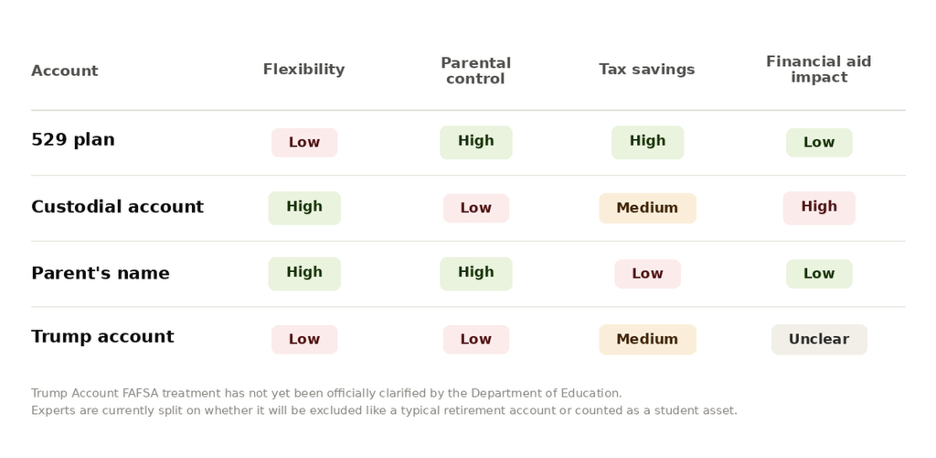
As you can see, there is no silver bullet in this group. They all have strong attributes and weaknesses, so it is important to build the right portion of each into your plan. I typically recommend people utilize a combination of 529 plans, custodial accounts, and a parent’s brokerage account to save for kids but every family’s circumstances are unique.
My savings meal for future kids will keep the meat and potatoes at the forefront. For us, that is a healthy portion of the 529 plan, though I am careful not to save too much over the $35,000 Roth conversion limit. The majority will sit in a custodial account, where we value the flexibility it provides. I also find value in continuing to build up funds in our family brokerage account, which can be used for lots of short to medium term goals, including some education savings.
Although I do not think it is a beneficial education savings tool on its own, I do think Trump Accounts have value if you have the ability to save for your children over and above college. College first, retirement savings after. The real benefit of this type of account is the long-term compounding that can happen. Remember the Rule of 72, (a simplified mathematical illustration commonly used to estimate how long an investment may take to double at a constant assumed rate of return),which says an investment can historically double if you take the number 72 and divide it by the expected return. Using a constant hypothetical rate of return of 7 percent, that is a potential doubling roughly every 10.3 years. For an infant with $5,000 added in year one, that money has the chance to potentially double twice, to about $20,000, before that child would really be able to start saving for retirement.
Saving for kids has become a hot topic with clients lately, especially as we work more and more with second, third, and even fourth generations of the same families. Keep an eye out in the coming weeks for an invitation to a webinar where Michele Daniher from our Cincinnati office and I will dig into the tricks and best practices for helping your kids financially.

Logan Gilland, CFP®, is Director of Wealth Management at Bluespring Wealth’s Lexington office, where he helps clients turn financial goals into practical plans. He also shares straightforward financial guidance through the DIY Money podcast, Savings & Sense radio show, and his weekly newsletter, Logan’s Lens. Outside the office, Logan and his wife, Hannah, enjoy hosting friends and planning their next national park trip.
The views expressed herein, including those of guests not affiliated with Bluespring Wealth, reflect the opinions of the author or speaker as of the date of publication, are not statements of fact, and are subject to change without notice. This communication is provided for informational and educational purposes only, does not constitute investment, tax, or legal advice. Any references to specific securities, products, or services do not constitute a recommendation or endorsement. All forward-looking statements and projections are subject to uncertainty and should not be relied upon as predictions of future results. All investments involve risk, including the possible loss of principal. Past performance of any security, index, strategy, or market is not indicative of future results. Any index performance referenced herein is provided for informational context only; indices are unmanaged, do not incur fees, and are not available for direct investment. Diversification and active management do not guarantee a profit or protect against loss in declining markets. Statistical data attributed to third parties is believed to be from reliable sources but has not been independently verified. Bluespring Wealth complies with the requirements of the SEC’s Marketing Rule with respect to the payment of referral fees or other compensation to promoters.